You Don't Learn to Be Alone by Yourself
Beneath the Surface · By Ali Daudji ·
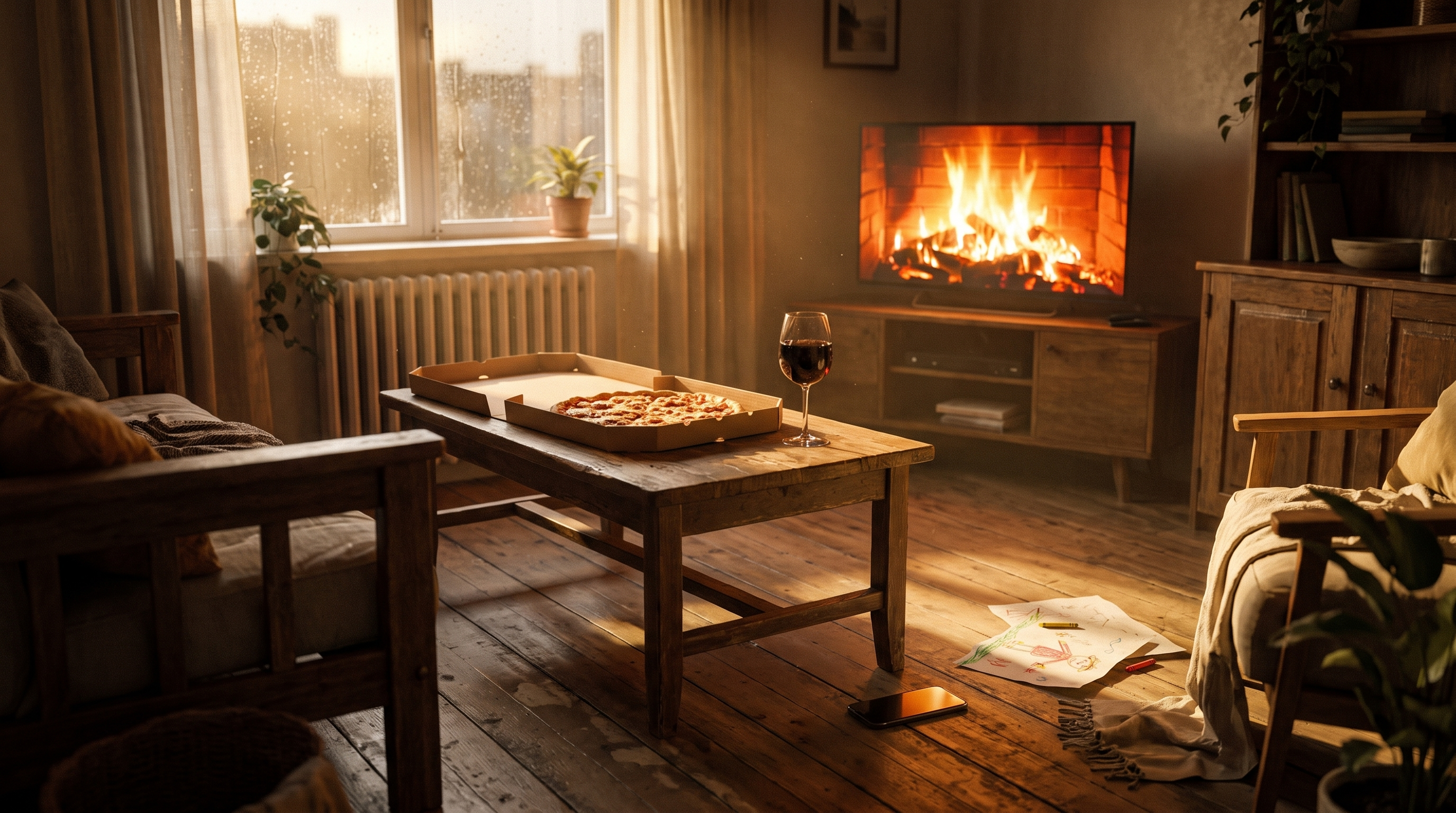
There is a woman on Instagram whose videos consist of almost nothing. She slides a premade pizza into the oven and pours herself a wine glass of Diet Coke. Some nights she dims the lights and lets a fireplace video crackle on the TV while rain falls outside the window. Nobody else ever appears. Her name is Lana Isa, and in June The Atlantic profiled her under the heading the genre has acquired, the solitude influencer, along with the number that makes the whole thing strange: 195,000 followers.
That many people, tuning in to watch one person be alone.
The appeal is easy to feel even at a description's distance. Calming, the way an aquarium is calming. But 195,000 people is not an audience for pizza. Something else is being supplied, and I think I know what it is, because a five-page paper from 1958 describes this audience almost exactly.
Here is the position I have come around to. You learn to be alone in company or you do not learn it at all. And if you never learn it, the gap does not stay private. It leaks into how you love.
In the summer of 1957, an English pediatrician read a short paper to the British Psychoanalytical Society, built on a lifetime of watching mothers and babies. Donald Winnicott called it "The Capacity to be Alone," and he opened with the claim the whole paper rests on, that the capacity to be alone "is one of the most important signs of maturity in emotional development." Capacity, not preference. Psychoanalysis, he noted, had written at length about the fear of being alone, and about the wish for it. Much less about the ability.
Then the paradox he is still quoted for. The capacity to be alone, he argued in the published version (the International Journal of Psychoanalysis), "is based on the experience of being alone in the presence of someone." Without enough of that experience, it never develops.
The scene behind the theory could not be more ordinary. A small child plays on the floor. Her mother is across the room with her own task, reliably there, wanting nothing. The child forgets her and sinks into whatever her hands are doing. She is alone, and she is not. Winnicott's claim is that if that scene repeats enough times, the child takes the presence inside. Years later she can sit in an empty apartment and the apartment will not feel like a verdict, because she never feels entirely unaccompanied. Some people walk into an empty room and find it furnished.
He was exact about what he was not saying. The condition of being alone is cheap. "A person may be in solitary confinement," he wrote, "and yet not be able to be alone." The condition and the capacity just look alike from the outside.
And one line in the paper reads like it was filed from this decade. A child who never gets to build the capacity, Winnicott warned, is left with "a false life built on reactions to external stimuli."
I don't know a better nine-word description of a smartphone.
I notice the tells in myself. A podcast queued for a four-minute walk. The reflex, when a feeling starts, to hand it to somebody by text before I know what it is, so that it becomes an update before it has a chance to become information. Some of what I have called staying in touch, if I'm honest about it, was a flare fired at the first sign of my own company. The room went quiet, so I started transmitting.
The reflex is not about the people I reach for. That is the uncomfortable part. Reaching for someone because you want them and reaching for someone because you can't stand the vacancy feel identical from the inside, and only one of them is about the other person at all. You cannot be fully close to someone you are partly using as an exit.
And the capacity decides what kind of company you are. Winnicott wrote the return trip in a single sentence: "Being able to enjoy being alone along with another person who is also alone is in itself an experience of health." Two people reading in the same room. A friend you can cook beside without narrating it. When someone calls a relationship easy, this is usually what they mean. Nobody in the room is being used.
Run your own relationships through it. There are people whose silence rests you and people whose silence reads as an alarm going off somewhere in the building, and the difference is rarely the silence. It is whether anyone present needs rescuing from themselves.
The kindest thing you can offer someone you love is not always attention. Sometimes it is being the person they can be alone in front of. Winnicott's job description for the mother is embarrassingly modest: "someone available, someone present, although present without making demands." A parent on the floor near a drawing child, wanted and ignored. You can hand a grown person the same gift in a kitchen, or on the other end of a phone line neither of you feels pressure to fill. Presence without appetite.
Back to the woman with the pizza. I no longer think 195,000 people subscribe to her evenings because they idolize being alone. They are borrowing the old arrangement. A presence nearby that asks nothing and gets on with her evening while you get on with yours. That is the room from 1957, streaming on demand. The dose is low enough that it can never disappoint, and low enough that it can never do what the original did. Watching somebody else's solitude is one more reaction to one more external stimulus. It rehearses the capacity without building any of it.
Tonight there will be a moment, after the last message, when the room goes quiet and your hand starts moving before you've decided anything. Catch it once. Ask what it is. Reaching for someone, or reaching away from being the only one here? One of those is connection.
The other is the fireplace video.